Is Event Management a Good Career Choice in 2026? An Overview of the Current Data
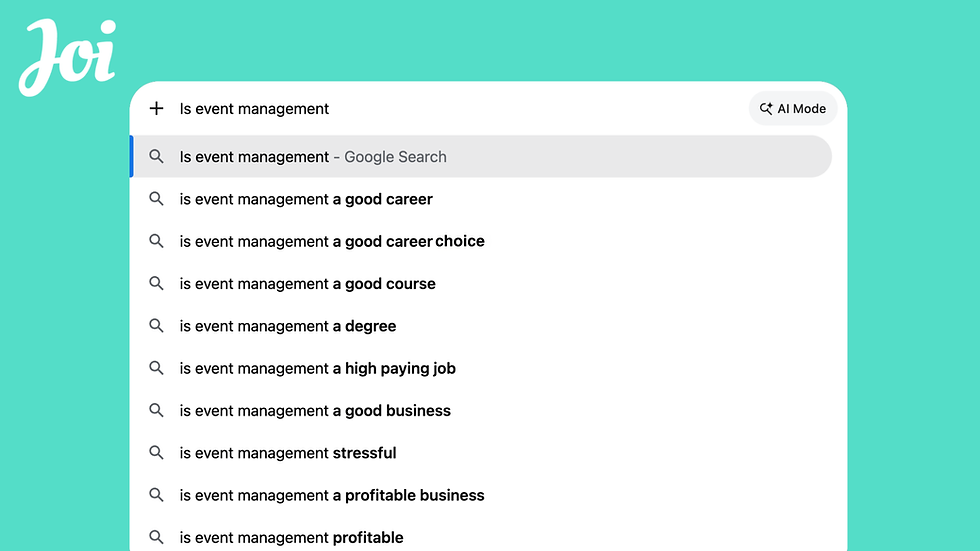
For years, careers in technology, finance, and consulting have dominated conversations about ambitious career paths. But quietly, another industry has been evolving into one of the most dynamic, creative, and rewarding places to build a career: events.
There is a long-standing tendency to dismiss careers in events management as peripheral to the real economy, the province of those who are good with people and comfortable with chaos but perhaps not quite suited to something more rigorous. The evidence, examined without a promotional gloss that often accompanies industry commentary, suggests that events professionals now occupy a position at the intersection of several of the defining forces of contemporary life in 2026: a global phenomenon of social disconnection, a record-breaking commercial pivot toward experiential marketing, the transformative but uncertain integration of artificial intelligence, and a growing institutional recognition that in-person human relationships, built in shared physical space, are neither interchangeable nor optional.
None of this means a career in events is without complexity or contradiction. The salary data is eye-opening relative to the industry's claimed strategic importance. Market growth projections vary so widely between analysts as to raise questions about what, exactly, is being measured. And the technology question, so often framed as reassuring, remains genuinely open. What follows is an overview of how and where to take the evidence seriously in regards to assessing a career in events, both where it is compelling and where it demands more careful scrutiny.
Events & the Loneliness Paradox
It has become commonplace to observe that digital technology connects us while also, somehow, isolating us. What is less commonly acknowledged is how formally and seriously this paradox has been treated by governments, healthcare bodies, and academic researchers over the past several years.
In 2023, the United States Surgeon General issued an advisory titled Our Epidemic of Loneliness and Isolation, which found that approximately half of all American adults experienced measurable levels of loneliness (U.S. Department of Health and Human Services, 2023). In the same year, the World Health Organisation launched its Commission on Social Connection; a three-year international initiative describing social disconnection as a global public health threat (World Health Organisation, 2025). The UK had already appointed a Minister of Loneliness in 2018; Japan followed in 2021. These are not merely symbolic gestures. They reflect an accumulation of clinical evidence that has become impossible to ignore.
The WHO Commission's 2025 report found that loneliness affected 1 in 6 people globally between 2014 and 2023, with young people aged 13 to 29 (the most digitally active cohort in history) reporting the highest rates, between 17-21% (World Health Organisation, 2025). A survey spanning 142 countries, conducted by Meta and Gallup (2023), found roughly 1 in 4 people aged 15 and older reported feeling very or fairly lonely. The Surgeon General's advisory drew on decades of epidemiological research to conclude that the health consequences of prolonged isolation are equivalent, in terms of mortality risk, to smoking up to 15 cigarettes a day, and that poor social connection is associated with a 29% higher risk of heart disease and a 32% higher risk of stroke (U.S. Department of Health and Human Services, 2023).
What does any of this have to do with events? The answer lies in what events actually are. At their most basic, they are deliberate interventions in the geography of human connection. A conference places people in a room. A trade show creates a context for relationships that might not form otherwise. A music festival; Glastonbury, Coachella, or a local venue drawing 60 people on a Saturday evening, produces something closer to collective ritual, a shared emotional experience that attendees carry with them long after the last set ends. A stadium filling with 80,000 people for a World Cup fixture, or a community fun run drawing together a neighbourhood that rarely pauses to meet itself, or a charity gala that turns institutional generosity into something felt rather than merely transacted, each of these is, at its structural core, the same thing: a designed encounter between people who would otherwise remain oblivious to one another, or who know each other only through a screen. The distinction matters because it reframes the value proposition of the events professional entirely. If social connection is a public health determinant on a par with diet and exercise, as the WHO's reporting frames it, then the people who design and deliver the conditions for that connection are doing something with consequences that extend well beyond any individual business outcome.
This is not to romanticise the industry or to suggest that an event planner is, in any direct or literal sense, a public health worker. The causal chain between attending an event and reducing loneliness is neither simple nor linear. But the structural context is real: the institutions most trusted to measure human wellbeing have concluded that the decline of in-person social interaction is producing measurable harm, at scale. An industry whose fundamental purpose is to bring people together in shared physical space is, in this context, doing something worth taking seriously.
The Commercial Data: The Value of the Event Industry
It is one thing to identify a social need but it is another to establish that the market has recognised and is responding to it. On this question, the commercial evidence is substantial though it demands a critical lens.
According to Allied Market Research (2025), the global events industry was valued at $736.8 billion in 2021, with projections suggesting growth to $2.5 trillion by 2035, at a CAGR of 6.8%. It is worth noting that market research projections for this sector vary considerably: different analysts have cited CAGRs ranging from approximately 5% to over 14%, depending on methodological approach, scope definition, and whether virtual and hybrid formats are included (SkyQuest, 2025; Zion Market Research, 2025; Expert Market Research, 2026). This variability does not invalidate the underlying growth story, but it should temper the uncritical citation of any single figure. What is consistent across reports is the direction: significant, sustained expansion across regions and event types.
The behaviour of brands and businesses provides arguably more reliable signal than projected valuations. Global experiential marketing spend reached a record $128.35 billion in 2024, surpassing pre-pandemic levels for the first time; a 10.5% increase on the prior year (PQ Media, 2024). UK businesses increased event spending by 23.1% in the first quarter of 2024, one of the sharpest rises tracked in any marketing category during that period by the IPA's quarterly Bellwether Report (IPA, 2024). Freeman's 2024 Attendee Intent and Behaviour Survey based on responses from audiences across multiple sectors found that 80% of respondents considered in-person events the most trusted marketing channel, a five percentage point increase from the prior year (Freeman, 2024).
The return on investment data is compelling. According to EventTrack 2025, the largest annual research study on experiential marketing, surveying over 1,000 Fortune 1000 corporate marketers, 74% of brands planned to increase their experiential marketing budgets in 2025, with 50% reporting improved ROI from event investments (Event Marketer, 2024). The commercial case is reinforced by Splash's 2024 Outlook on Events, which surveyed 1,255 marketers across the US and UK: 77% identified live events as the most effective marketing channel their organisation uses, and 83% described events as critical to their business growth (Splash, 2024).
These figures raise a question that the events industry itself has sometimes been slow to articulate clearly: if in-person experiences produce this level of commercial return and this level of attendee trust, why has the strategic contribution of events professionals been historically under-acknowledged, including in terms of compensation?
A Career in Events: From Logistics to Experience Architecture
The traditional framing of events work as primarily logistical; venues, catering, schedules, suppliers has always been an incomplete picture. But over the past decade, the gap between that framing and the reality of the job has widened to the point where they are barely recognisable as the same thing.
An events professional working at any meaningful scale today is, depending on the context, a data analyst interpreting attendee behaviour, a content strategist shaping an audience journey across multiple touch points, a community manager sustaining engagement between events, a technology integrator selecting and implementing platforms, and a commercial strategist capable of demonstrating ROI to boards and senior leadership. The shift is not merely cosmetic. As organisations have come to treat events as a primary mechanism for customer acquisition, employee engagement, brand building, and relationship development, the expectations placed on events professionals have expanded accordingly.
This has particular implications for how the career is understood from the outside. People with strong analytical, strategic, or technological skills who might previously have overlooked events as insufficiently rigorous are, in growing numbers, finding that those skills translate directly into high-value roles within the sector. Conversely, those who entered events primarily for the creative and logistical dimensions are being asked to develop competencies (data literacy, technology fluency, ROI articulation) that were not part of the job ten years ago.
Whether this expansion of scope represents an opportunity or a pressure depends partly on who you ask. What is harder to dispute is the genuine breadth of skill the profession now develops. The Bureau of Labor Statistics (2025) highlights communication, leadership, problem-solving, stakeholder management, and project delivery as core competencies cultivated through events work. CareerExplorer (2023) notes that these skills transfer almost seamlessly across industries, a resilience that distinguishes very few career paths and that has real value in an economy where the average tenure in any given role continues to shorten. Prospects (2026) identifies events management graduates as attractive to employers across the private, public, and non-profit sectors precisely because the degree develops both commercial and creative capability simultaneously.
The transferability argument, it should be noted, cuts in two directions. If events skills enable relatively seamless movement into adjacent industries, this supports the case for events as a long-term career investment but it also raises the question of whether the industry retains its best people, or whether it functions, for many, as an accelerant into something else. An honest consideration of a career in events has to acknowledge this tension rather than suppress it.
Technology, AI & Events: Amplifier, Disruptor, or Something More Uncertain?
No discussion of the near-term future of events careers is complete without a serious engagement with artificial intelligence, and that engagement requires resisting the twin temptations of panic and false reassurance.
The AI in event management market was valued at $1.8 billion in 2023 and is projected to reach $14.2 billion by 2033, growing at a CAGR of 22.9% (Market.us, 2024). According to research by Event Industry News and EventMobi (2025), 45% of event organisers and directors are already actively using AI tools to enhance operations and personalise the attendee experience. The American Express Global Business Travel 2025 Global Forecast found that half of all meeting planners worldwide planned to integrate AI into their workflows by 2025 (American Express Global Business Travel, 2025).
The prevailing narrative within the industry is that AI will automate the repetitive and logistical (registration, communications, data capture, real-time analytics, translation) while freeing professionals to focus on the creative and strategic work that distinguishes a good event from a forgettable one. But the more penetrating question is not whether AI saves time. It is what happens to the professional identity and career progression of event workers as the tasks that once constituted the learning curve are automated away. Entry-level events roles have historically been how people develop instinct; for timing, for audience behaviour, for the relationship between a decision made at a desk and its consequences in a room full of people. If those roles are compressed or eliminated, the pipeline of experienced mid-career professionals becomes a question worth asking.
The honest answer is that nobody knows yet. What the evidence does suggest is that the events professionals most likely to flourish in an AI-integrated environment are those who can operate at the intersection of human judgment and technological capability, who understand what tools can and cannot do, who can interpret data without being enslaved by it, and who bring to their work a quality of relational intelligence that no system, however sophisticated, currently replicates. That is not a comfortable formula, but it is for the most part, an accurate one.
Event Career Outlook and the Salary Question
The Bureau of Labor Statistics (2025) projects employment of meeting, convention, and event planners in the United States to grow by 5% between 2024 and 2034, a rate described as faster than the average across all occupations, with approximately 15,500 new positions projected annually over the decade. The comparable figure from CSUN's Tseng College (2025) cites 16,500 annual openings projected between 2023 and 2033, based on BLS data from an adjacent reporting cycle. The direction is consistent, even where precise figures differ.
What demands closer scrutiny is the salary data. The median annual wage for meeting, convention, and event planners in the United States stood at $59,440 in May 2024, with the top quartile earning above $77,150 and the lowest 10% earning below $35,990 (Bureau of Labor Statistics, 2025; U.S. News and World Report, 2024). At the senior end, the median salary for event managers reached approximately $63,000 by May 2025, with experienced practitioners earning upwards of $71,000 (CSUN Tseng College, 2025).
Held against the scale of commercial value the industry claims to generate, with the global events industry predicted value at $2.5 trillion by 2035 (Allied Market Research, 2025), 74% of Fortune 1000 marketers planning to increase experiential budgets further in 2025 (Event Marketer, 2024), and 83% of marketers surveyed across the US and UK identifying events as critical to their business growth (Splash, 2024), these figures raise a legitimate question about whether the profession is adequately compensated for the strategic role it now plays. This is not a reason to avoid the industry. But it is a reason to approach it with clear expectations, and to recognise that the most significant salary growth is likely to accrue to those who can position themselves at the senior, technology-literate, commercially fluent end of the profession.
The career's genuine strength lies not in its income ceiling but in its breadth and resilience. Healthcare, financial services, technology, professional associations, government bodies, and educational institutions all invest substantially in professionally managed events. The diversity of sectors requiring event expertise means that a career in this field is not hostage to the fortunes of any single industry; a form of structural security that should not be underestimated.
Open Questions: What the Growth Narrative Does Not Settle
The case for events as a valuable and rewarding career is, on balance, a strong one. However, a genuine account of any industry requires looking at what the growth figures do not show. Growth narratives have a tendency to flatten what they describe and this one is no exception. The data points in a favourable direction but the questions that deserve attention point in several.
First, the relationship between events and the loneliness phenomenon is structural rather than causal. Events do not straightforwardly solve loneliness; poorly designed ones can reinforce it. The research on social connection tells us that the quality of interaction matters as much as its frequency and that large-scale events, in particular, can produce the sensation of belonging without the substance. Whether the events industry in its current form is actually serving the connection needs it’s positioned to address, or primarily serving the commercial interests of those who fund it, is a question worth noting as an industry that positions itself as the antidote to disconnection has a responsibility that goes beyond filling rooms.
Second, the sector's growth projections assume a continuation of conditions (rising corporate investment, consumer appetite for live experience, supportive macroeconomic environment) that are not guaranteed. Events budgets are among the first casualties of economic contraction, a pattern observed in 2008 and again, briefly, in the pandemic period. The long-term structural demand for human connection is real; whether that demand translates into consistent investment in professionally managed events through economic cycles is a separate and less certain proposition.
Third, sustainability represents perhaps the most structurally uncomfortable pressure the industry faces, because it sits in direct tension with the thing that makes events work. Sustainability requirements featured in just 14% of event planning briefs in 2019; by 2023 that figure had reached 31%, and by 2024 it had nearly doubled again to 60% (PCMA, 2024a; 2024b), a rate of change that suggests the industry is beginning to respond, even if the distance still to travel remains considerable. As environmental scrutiny of large-scale gatherings intensifies in terms of carbon footprint, resource consumption, and travel, the industry will be up against the harder work of ensuring the industry actually delivers on what it promises and whether the professionals shaping the industry will demand this standard of themselves or settle for the commercial metrics that are easier to measure.
None of these tensions invalidate the case for events as a good career but they do shape what kind of career it is most likely to be: one that rewards those who can think critically, adapt continuously, and bring to the work a quality of judgment that transcends any single skill set or tool.
Concluding Thoughts
There is something quietly significant happening in the relationship between digital technology and human experience. The two forces that were once assumed to be converging, and that as our digital lives became richer our appetite for physical gathering would diminish, have not converged at all. They have indeed diverged and thus are producing a version of the events industry that is structurally more important, commercially more sophisticated, and professionally more demanding than at any previous point in its history.
A career in events is, at its core and in this particular moment in history, a well-supported bet. It is a commitment to the idea that there are things which happen in shared physical space that cannot be replicated by any platform, algorithm, or virtual environment, however well-designed. The loneliness data, the investment flows, the employment projections, and the technology trajectory are not pointing in the same direction by coincidence. They reflect a genuine and growing recognition that presence matters and that the people who know how to design for it are becoming harder to find and more valuable when found.
The numbers reveal growth, but they cannot answer the questions that matter most: what experiences deserve to exist, for whom, and at what cost? The data can tell us where the industry is heading, but it cannot decide where it ought to go. That responsibility belongs to the people designing the experiences, questioning assumptions, and raising expectations of what events can achieve. It is perhaps the most exciting reason of all to consider joining it!
References & Further Reading
Allied Market Research (2025) Events Industry Market by Type, Revenue Source, Organizer, Age Group, Origin of Attendees, and Event Location: Global Opportunity Analysis and Industry Forecast, 2024–2035. Available at: https://www.alliedmarketresearch.com/events-industry-market
American Express Global Business Travel (2025) Meetings and Events 2025 Global Forecast. New York: American Express Global Business Travel. Available at: https://experience.amexglobalbusinesstravel.com/me-forecast/2025/
Bureau of Labor Statistics (2025) Meeting, Convention, and Event Planners: Occupational Outlook Handbook. U.S. Department of Labor. Available at: https://www.bls.gov/ooh/business-and-financial/meeting-convention-and-event-planners.htm
CareerExplorer (2023) The job market for event planners in the United States. Available at: https://www.careerexplorer.com/careers/event-planner/job-market/
CSUN Tseng College (2025) Event Manager Salary and Job Outlook. California State University, Northridge. Available at: https://tsengcollege.csun.edu/blog/event-manager-salary
Event Industry News and EventMobi (2025) How AI Will Transform The Events Industry 2025. Available at: https://www.eventindustrynews.com/guides/event-industry-news-launches-groundbreaking-ai-report-2025-in-partnership-with-eventmobi
Event Marketer (2024) EventTrack 2025: Experiential Marketing Forecast and Benchmark Study. Rockville, MD: Event Marketer Magazine and Sparks. Available at: https://www.eventmarketer.com/article/eventtrack25/
Expert Market Research (2026) Events Industry Market Size, Share & Forecast 2035. Available at: https://www.expertmarketresearch.com/reports/events-industry-market
Freeman (2024) 2024 Attendee Intent and Behavior Survey. Dallas: Freeman. Available at: https://www.freeman.com/about/press/freeman-launches-new-attendee-intent-and-behavior-trend-report/
Institute of Practitioners in Advertising (IPA) (2024) IPA Bellwether Report: Q1 2024. London: IPA. Available at: https://ipa.co.uk/news/bellwether-report-q1-2024
Market.us (2024) AI in Event Management Market Size: CAGR of 22%. Available at: https://market.us/report/ai-in-event-management-market/
Meta and Gallup (2023) State of Social Connections: A Survey of 142 Countries. Menlo Park, CA and Washington, DC: Meta Platforms and Gallup. Available at: https://www.gallup.com/analytics/509675/state-of-social-connections.aspx
PCMA (2024a) 'A sustainability pulse check for events', Convene. Available at: https://www.pcma.org/sustainability-pulse-check-events/
PCMA (2024b) 'Business events: we're about halfway there with sustainability', Convene. Available at: https://www.pcma.org/business-events-halfway-there-with-sustainability/
Prospects (2026) What can I do with an events management degree?. Available at: https://www.prospects.ac.uk/careers-advice/what-can-i-do-with-my-degree/events-management/
PQ Media (2024) Global B2C & B2B Experiential Marketing Forecast 2024–2028 [press release]. PRWeb, 14 October. Available at: https://www.prweb.com/releases/global-experiential-marketing-to-finally-outpace-pre-pandemic-spending-in-2024--rising-10-5-to-reach-128-35-billion-compared-with-121-87-billion-in-2019--302273698.html
SkyQuest (2025) Global Events Industry Market Size, Share, Growth, and Forecast 2025–2033. Available at: https://www.skyquestt.com/report/events-industry-market
Splash (2024) 2024 Outlook on Events [online press release]. PR Newswire, 21 February. Available at: https://www.prnewswire.com/news-releases/splash-releases-2024-outlook-on-events-report-reveals-event-programming-ignites-revenue-growth-302066811.html
U.S. Department of Health and Human Services (2023) Our Epidemic of Loneliness and Isolation: The U.S. Surgeon General's Advisory on the Healing Effects of Social Connection and Community. Washington, DC: U.S. Department of Health and Human Services. PDF: https://www.hhs.gov/sites/default/files/surgeon-general-social-connection-advisory.pdf
U.S. News and World Report (2024) Meeting, Convention and Event Planner: Career Rankings, Salary, Reviews and Advice. Available at: https://careers.usnews.com/best-jobs/meeting-convention-and-event-planner
World Health Organisation (2025) From Loneliness to Social Connection: Charting a Path to Healthier Societies. Report of the WHO Commission on Social Connection. Geneva:
World Health Organisation. Available at: https://www.who.int/publications/i/item/978240112360
Zion Market Research (2025) Events Industry Market Size, Share, Trends, Analysis and Forecast, 2025–2034. Available at: https://www.zionmarketresearch.com/report/events-industry-market


Comments